
'The people who were protesting and getting violent were all in the age group of 14-25.'
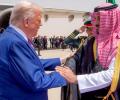
'I said, fellas, come on, let's make a deal, let's do some trading, let's not trade nuclear missiles, let's trade the things that you make so beautifully, and they both have very powerful leaders, very strong leaders, smart leaders, and it all stopped.'
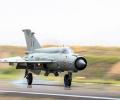
The MiG-21 episode demonstrates that procurement is always strategic.
Choices about what aircraft to acquire, who builds them, who supplies the spares, who trains the pilots and technicians are decisions with political consequences lasting for decades.

India's top listed real estate developers - DLF, Lodha Group, Prestige Estates, and Oberoi Realty, excluding Godrej Properties - reported strong presales growth in the first quarter (Q1) of 2025-26 (FY26), even as earnings showed a mixed trend. According to Nomura, the top five developers - DLF, Lodha, Prestige, Oberoi, and Godrej - recorded a cumulative 59 per cent year-on-year (Y-o-Y) growth in presales.
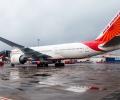
Air India and Air India Express on Tuesday progressively resumed their services to the Middle East, with flights to Dubai and Muscat, respectively, as countries in the region reopened their airspaces.

US Secretary of State Marco Rubio claims President Donald Trump was instrumental in bringing about the cessation of hostilities between India and Pakistan, a claim India has consistently denied.

Describing the Indian Ocean as a living testament to long-standing ties between the Maldives and India, Maldivian President Mohamed Muizzu has said that the two nations have forged a resilient and unbreakable bond that extends far beyond diplomacy.
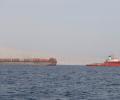
US strikes on Iran's three main nuclear facilities have once again raised concerns that Tehran might shut down the Strait of Hormuz - one of the world's most critical chokepoints, through which a fifth of global oil and gas supply flows.

'Famine in Gaza is not a failure of logistics or aid. What is to blame is deliberate starvation caused by a brutal war.' 'Any child dying in a war zone is a vote of no confidence against humanity.'
The United States stands strong with India against terrorism and Prime Minister Narendra Modi 'has our full support', the State Department said underlining that Secretary of State Marco Rubio urges India and Pakistan to work towards a responsible resolution that maintains long-term peace and regional stability in South Asia.
Prime Minister Narendra Modi will travel to China to attend the Shanghai Cooperation Organisation (SCO) summit, marking his first visit in over seven years. The visit signals a potential improvement in India-China relations after recent tensions.
United States President Donald Trump will host Pakistan Army chief Asim Munir for lunch at the White House on Wednesday.

Climate activist Sonam Wangchuk called off his hunger strike as protests for Ladakh statehood and Sixth Schedule extension turned violent. The BJP office was set on fire, vehicles were torched, and clashes erupted, leading to the imposition of prohibitory orders.
Prime Minister Shigeru Ishiba's sudden resignation after only a year in office has thrown Japan into political turmoil, raising doubts about how the country will handle economic and regional challenges, observes Dr Rajaram Panda.
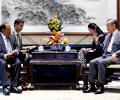
India and China are expected to discuss new confidence-building measures for durable peace and tranquillity along their contested border during Chinese Foreign Minister Wang Yi's two-day visit to India. The visit is seen as an effort to rebuild relations after the Galwan Valley clashes.

The closed-door luncheon meeting came amid escalating tensions between Israel and Iran with Trump exploring Washington's possible involvement.

A major escalation unfolded in West Asia on Monday after Iran reportedly launched multiple missiles targeting United States military installations in Qatar and Iraq, including Al Udeid Air Base in Qatar -- the largest US military installation in the region, according to a CNN report.
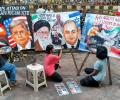
Prime Minister Narendra Modi on Sunday conveyed to Iranian President Masoud Pezeshkian India's 'deep concern' over Iran's conflict with Israel and called for immediate de-escalation of the situation through 'dialogue and diplomacy'.

The Global Times, a prominent state-run Chinese media outlet, published an article titled "China and India are cooperation partners, not rivals: Xi," highlighting President Xi Jinping's remarks about the bilateral meeting, saying, "as long as the two countries stick to this overarching direction, China-India relations can sustain steady and long-term growth."
In a statement after a meeting between Trump and Pakistan Army chief Asim Munir at the White House on Wednesday, the Inter-Services Public Relations -- the media wing of the Pakistan Army -- said they also discussed joint counterterrorism efforts.
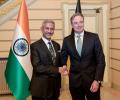
The era where nations thrived through rigid alignments is giving way to an age where the connective State defines power. For India, that era has arrived, points out Dr Nishakant Ojha.
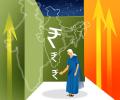
S&P Global Ratings on Tuesday upped India's GDP growth forecast for the current fiscal to 6.5 per cent, citing lower crude prices, monetary easing and normal monsoon, and said the ongoing geopolitical tensions are unlikely to put a "significant pressure" on the rupee or inflation.
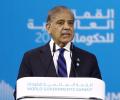
Sharif said that the US president had shown beyond any doubt that "he is a man for peace... and beneficial business deals".

Gold prices are expected to witness further consolidation in the coming week as investors brace for a slew of events, ranging from central bank meetings, including the US Federal Open Market Committee (FOMC) meeting's outcome, to global trade negotiations, analysts said.
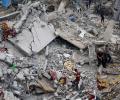
"Intermittent pauses in hostilities are not enough to address the scale of humanitarian challenges confronting the people, who grapple daily with acute shortages of food and fuel, inadequate medical services and lack of access to education," Harish said at the open debate on the 'Situation in the Middle East, including the Palestinian question'.

'These Marathas are farmers and they only do farming. They have no other business other than farming. Now, they want reservations because farming is no longer a profitable business.'In this interview, veteran farmers' rights advocate and founding member of the Shetkari Sanghatna, Vijay Jawandhia, with Syed Firdaus Ashraf/Rediff unpacks the historical and structural roots of the agitation.
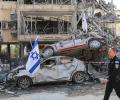
Iran fired around 200 ballistic missiles and drones at Israel on Saturday, June 14, 2025, causing widespread damage in communities in north Israel, killing three people and injuring dozens.

'Many are saying that some significant announcement regarding Jammu and Kashmir or even separate statehoods might come; that possibility cannot be ruled out given today's date.'
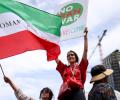
China and Russia on Sunday strongly condemned the United States air strikes on Iranian nuclear facilities, with China calling it a serious violation of the United Nations Charter that heightens tensions in West Asia, and Russia terming the strikes 'irresponsible' and asserting that they grossly violate international law, the UN Charter, and UN Security Council resolutions.
S&P Global Ratings on Thursday said the hostilities between India and Pakistan heighten risks to the credit metrics of both countries, and any escalation in clashes would put downward pressure on sovereign credit support.

"It is still not too late. India must speak clearly, act responsibly, and use every diplomatic channel available to defuse tensions and promote a return to dialogue in West Asia," Gandhi asserted.

His successor issue is also expected to flare up fresh tensions between Beijing and Washington as China's policy comes in conflict with the US Tibetan Policy and Support Act of 2020, which reaffirmed America's steadfast support for the Dalai Lama and Tibetan Buddhism.

India-US relations, like Rome, were not built in a day, nor can they be demolished in a day.
All said and done, when the new global order emerges, India can only remain with the democracies, asserts Ambassador T P Sreenivasan.

The convoy of West Bengal's Leader of Opposition, Suvendu Adhikari, was allegedly attacked by TMC workers during a protest in Cooch Behar. Bulletproof glasses of Adhikari's vehicle were smashed. TMC denies involvement, calling it a 'well-scripted drama'.

'...without massive amounts of force.'
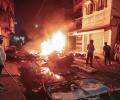
Maharashtra has witnessed 823 incidents of communal unrest since January this year, with demands for the removal of Aurangzeb's tomb and the spread of distorted facts on social media fomenting fresh trouble. Districts like Nandurbar, Pune (Rural), Ratnagiri, Sangli, Beed, and Satara have seen communal unrest in recent days due to right-wing organizations' demands for the demolition of the Mughal emperor's tomb in Chhatrapati Sambhajinagar. The state witnessed 4,836 Hindu-Muslim related communal crimes in 2024, with 170 incidents classified as cognisable and 3,106 as non-cognisable cases. The violence in Nagpur, triggered by protests demanding the removal of Aurangzeb's tomb, highlights the role of social media in spreading inflammatory content and instigating people. While the state has taken measures to curb the spread of misinformation, concerns remain over the impact on communities and the need for promoting peace and understanding.

Brent crude oil prices can touch $150 a barrel (bbl) - up a whopping 103 per cent from the current levels - in the worst-case scenario if the Israel-Iran geopolitical tensions escalate, suggest analysts.

Lee Jae-myung's decisive victory in South Korea's snap presidential election marks a major political shift driven by public backlash against authoritarian, with significant implications for domestic reform and the future of the US-South Korea alliance, observes Dr Rajaram Panda.

The Pakistan Army continued shelling along the Line of Control (LoC) in four sectors of Jammu and Kashmir, prompting a befitting response by the Indian Army, officials said on Thursday. The intensity of cross-border firing was less than Wednesday, when Pakistan Army carried out one of the most intense artillery and mortar shelling in years targeting the forward villages in J-K following missile strikes by India as part of 'Operation Sindoor'.
'Militarily, it risks escalating tensions with Pakistan, potentially triggering conflict due to Pakistan's heavy reliance on the Indus.'
